YOU SHOULD BE USING AN AUTOMATIC INLET STABILIZER IF:
- Your pump draws from a non pressurized tank
- Suction piping is long, undersized, or elevated
- You are pumping viscous or shear sensitive fluids
- You’ve experienced unexplained diaphragm or valve wear
- Inlet pressure looks acceptable, but pumps still fail
The Blacoh SENTRY™ Automatic Inlet Stabilizer (also called a suction stabilizer) is designed for 1.5” and 2” pumps and features a fully automatic air control with integrated venturi valve. It acts as an accumulator to store fluid and release it back into the line as needed. When the pump tries to pull fluid in, instead of creating a harsh pressure drop, the Automatic Inlet Stabilizer releases some of its stored fluid. When the pressure normalizes, the inlet stabilizer refills. It’s like having a small reservoir that smooths out the “gulping” action of the pump. Virtually all acceleration head loss is eliminated because the pump draws fluid from the dampener instead of the pipeline, avoiding the risk of cavitation and ensuring complete chamber fill on each inlet stroke of the pump.
This is particularly important when pumping from a non-pressurized tank or when dealing with viscous fluids that don’t flow easily.
- Prevents acceleration head-induced pressure spikes.
- Prevents cavitation at the pump inlet.
- Prevents incomplete chamber fill.
- Prevents premature diaphragm and valve failure.
- Prevents misleading inlet pressure readings.
- Proudly made in the USA.
AIR CONTROL OPTIONS
NEW! AUTOMATIC
Available only on the SENTRY Automatic Inlet Stabilizer
Permanent source of compressed gas is required. Incorporates a fully integrated, automatic venturi valve designed to accommodate negative pressures within the system. This dual-control mechanism ensures optimal system performance in both suction & positive pressure conditions.
PRESSURE IS WELL BELOW 10 PSI. WHY IS MY PUMP FAILING?
Average inlet pressure does not relfect instantaneous acceleration spikes.
This is why pumps fail below the manufacturer's maximum inlet limit.
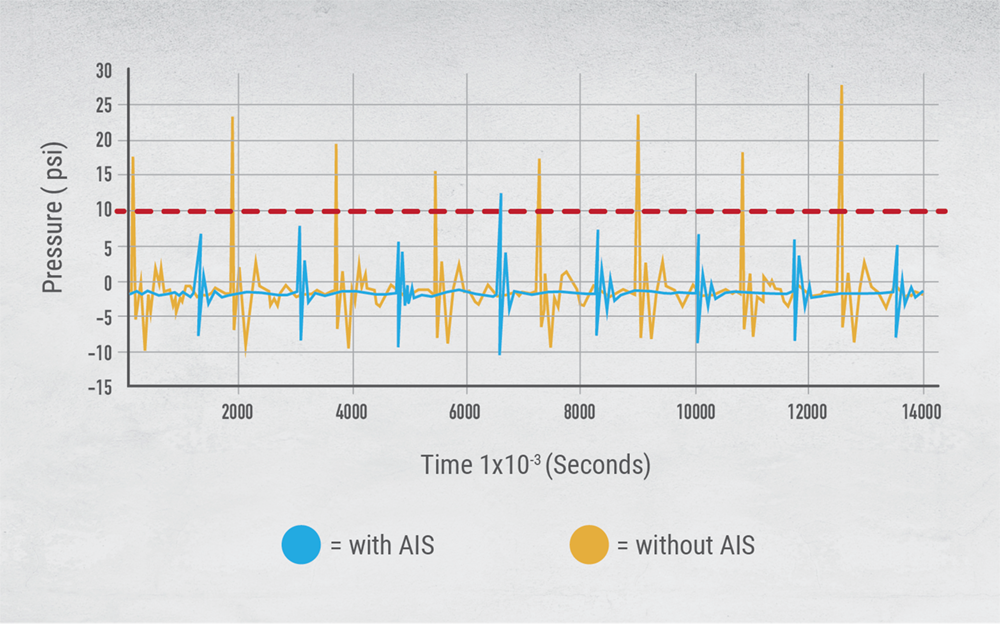
The chart above shows the effect on pump inlet pressure with and without the SENTRY Automatic Inlet Stabilizer (AIS), and compares that to the maximum inlet pressure allowed by the pump manufacturer, which is 10 psi. Even if the average pressure is almost zero, there are acceleration spikes that push well above that limit without the inlet stabilizer.
The AIS decreases pulsation severity, keeping the pressure spikes under that 10 psi limit significantly more often. Furthermore, the AIS helps system pressure stabilize more quickly following a pressure spike.
Decreasing fluid pulsation in this manner will decrease the likelihood of damage being caused to the pump and its components, increasing pump lifespan and ultimately saving money.
You can read more about inlet stabilizers and how they can protect your system on our blog.
HOUSING MATERIALS: Stainless Steel
DIAPHRAGM MATERIALS: PTFE,
INLET SIZES:1.5", 2"
INLET TYPES: FNPT, BSP, ANSI Flange, Tri-Clamp
PRESSURE RATINGS: 150 psi (10.3 bar)
AIR CONTROLS: Automatic
CERTIFICATIONS: ATEX
DIMENSIONS
| A |
B |
C |
10.43"
265mm |
10.6"
270mm |
13.75"
350mm |